Is Planned Parenthood An Abortion Clinic?


Obviously, planned parenthood is an abortion provider, and they happen to be the single leading abortion provider in the U.S. But is that what they are “about”? Is that their overriding focus? Or should they be understood primarily as a women’s health clinic, a family support center, or an adoption agency? You can answer these for yourself but I recommend seeing where their services predominate (see below). Of course, administering one condom is not practically the same clinical expense, human resource, or overall cost equivalent to an abortion, but, nevertheless, it is apparent that Planned Parenthood does deal in a a wide range of family planning services.

* See Planned Parenthood, “Annual Report 2007-2008),” New York, NY: Planned Parenthood Federation of America, page 9, accessed 8 May 2013 at: http://www.jillstanek.com/pp%20annual%20report%2007-08%20slide%201.JPG

Looking at this chart and others like it, from 1997 to 2007, independent reporter Jill Stanek renders the “Abortion services” and “other Services” in chart form like this:

pp adoption.jpg

In this chart the abortion services clearly outweigh distinctly pro-life options of adoption and prenatal care (i.e., preparing/planning for childbirth). But this chart is only dealing with a triad of services: abortion, adoption and prenatal care. These are thematically related in dealing with abortion and its only alternatives. One might fault this chart for addressing only 5% of Planned Parenthood’s services. Still, that 5% constitutes a major revenue source for PP. Indeed, their actual revenue for abortions is obscured. It is no secret that a great deal of PP’s external funding, that is, charitable giving and investing, is requested for the purpose of “providing abortion access” to women, especially underprivileged, poor, and immigrant women (see here for an example of that marketing strategy).

Husbands and males in general are not targeted, though they are roughly 50% of all families. Planned Parenthood targets, at most, 50% of parents. It’s focus is not adoptive fathers, or husbands who want to keep the baby, or boyfriends who oppose abortion, or foster parenting young boys. Planned Parenthood is widely acknowledged as a women’s clinic.

But reputation isn’t everything. How does Planned Parenthood present itself or see itself? On Planned Parenthood’s Website “abortion” displays prominently on the front page (under “The Facts On”). The running themes are not preparing for children, neonatal care, marriage counseling, or anything of that sort. Those aren’t mentioned. The lead articles/links (as of 29 May 2013) are:

* Abortion
* Birth Control
* Morning After Pill
* Sexually Transmitted Diseases
* Breast Cancer Screenings
* “Worried? Had Unprotected Sex?”
* “What kind of birth control is right for you?”
* “A Step Forward: FDA Approves Plan B [morning after pill] without a prescription for Women 15 and Older”
* “Am I Pregnant? We’ll Help You Find Out.”

Of the lead articles links only one of these is NOT about sex or pregnancy (i.e., Breast Cancer Screenings) And none of them are directly about planning FOR parenthood. Meanwhile, four of these are directly about preventing parenthood (Abortion, Morning After Pill, “Worried? Had Unprotected Sex?,” and “A Step Forward”). It seems that Planned Parenthood, according to its own storefront, is not about planning for parenthood as much as planning AGAINST parenthood. Parenthood then is not the focus of PP, rather sex and pregnancy are the prominent features. One can only glean so much useful data from a front-page of a website though. Perhaps Planned Parenthood should be judged by other lights.

The Front Page Link “Info For Teens” opens to a page with links to sex and masturbation, LGBTQ (Lesbian, Gay, Bisexual, Transvestite, and Queer), relationships, pregnancy, “How long does it take to get pregnant after sex?,” and “Am I Normal?” (a sex-ed video). Nowhere is parenthood mentioned, nor adoption, nor marriage, nor pre-marital counseling, nor is motherhood celebrated, nor are kids directly encouraged to plan for parenthood or marriage or family. The nearest approximation to “family” is a link to “relationships.” The emphasis is instead on unwanted pregnancies and sexual exploration. Without overtly declaring a high view of abortion, the page clearly expounds values consistent with an abortion emphasis.

The Front Page Link “Info For Parents” fares slightly better than the “Teens” link, perhaps since the audience for that link is already parents acting as family in caring for their children. Still, the emphasis on this page is not about marriage, marital health, fathers, or even family, but instead the focus is on sex and how to help young people either delay sexual activity or have safer sex. There are no links or articles on adoption, abstinence only education, or any distinctly “conservative” answers to the problem of teen pregnancy. Again, the values and assumptions align overwhelmingly with an abortion emphasis.

The Front Page Link “Info for Educators” is even more explicitly sex focused as it is not about preparing for parenthood, pre-marital counseling, marital counseling, fostering traditional gender roles, neo-natal care, or any of those kinds of education that can affect parental relationships. The “Educators” in mind are sex educators, and again, there is no clear place here for abstinence-only models of sex education. The value set, once again aligns with a socially-left leaning pro-choice agenda. Without overtly touting abortion, there is no mistaking the role abortion typically serves within socially left positions such as that of Planned Parenthood.

The relationship between sex and pregnancy is so obvious it barely needs mentioning. But here, it’s important to point out that Planned Parenthood is clearly pro-sex, which is what one would expect if they are to keep up a steady stream of abortion-seeking patients. In a broad sense, Planned Parenthood’s sex education operates on the sexual liberation philosophy where young people are encouraged to experiment with sexual play and masturbation, and it is assumed that young people (generally) are headed, unavoidably, towards extra-marital sex. No one’s disputing that many young people will have sex. But their dismissive treatment of Abstinance Only education and their normalizing portrayal of non-family contexts for pregnancy serve to reinforce their role in preventing pregnancy. But the philosophy of sexuality at work in Planned Parenthood seems to be socially and political progressive. That means they seem to question the necessity of traditional marriage, traditional gender roles, the sanctity of motherhood, and other socially conservative maintstays. This philosophy bolsters and encourages a pro-choice politic and aligns them with socially and politically left leaning funding sources. Married women are far less likely to have abortions, and unmarried pregnant women are most-often non-conservatives. Abortion is widely touted as a solution, primarily for underprivileged, immature, and otherwise reluctantly inexperienced teen mothers.

Even still Planned Parenthood provides many services besides abortion, and abortion is only a small fraction at that, so shouldn’t they be treated primarily as a women’s clinic and not as an “Abortion Clinic?” Well, those numbers are misleading. Planned parenthood still provides about 1/4 to /3 of all U.S. abortions annually at about 334,000 a year for the last three years, and about 1, 000,000 total over that period. Even if Planned Parenthood provides many different services, they are also the well-recognized leading source of abortions with no single competitor that comes close.

Perhaps the most relevant fact undermining PP’s status as a “Women’s Clinic,” is that PP receives 45% of its funds from the Government. This fact may, at first, seem innocuous or even contradictory to “Abortion Clinic” status. But there is a complex legal history surrounding government funding of abortion. The Beal v. Doe (1977) and Harris v. McRae (1980) rulings established legal grounds to deny state funding for abortions. Plus, there is pending legislation that could prohibit Federal funding for abortion. Planned Parenthood as a vested financial interest in presenting itself as a Women’s Clinic that happens to offer abortion services. Otherwise, they would be simply an Abortion Clinic and states with strong conservative leaders or conservative demographics could obstruct their funding. Planned Parenthood still does offer services besides abortion, but they are pressured to do so by their practical need of funding.

Still someone might suggest that specific services that Planned Parenthood’s specifically offers such as breast cancer screenings. This is true, but they are not licensed or able to provide mammograms or advanced detection measures. Planned Parenthood can only provide the earliest preliminary tests for breast cancer, such as instructing self-examinations and topical examinations, and then give referrals to relevant Medical Doctors such as Ob-Gyn’s, Endocrinologists, or Oncologists. Planned Parenthood can help in that regard and their services there should not be dismissed. But neither do such measures demonstrate that Planned Parenthood is not primarily an abortion clinic.

Furthermore, in regards to women who are already pregnant, Planned Parenthood overhwelmingly favors abortion over other alternatives. PP gave only 2,300 adoption referrals and only 30,000 neo-natal services according to recent stats from PP. Combining those non-abortion options, the total is about 32,300. Their abortion count is more than 10x’s that amount, or more than 1,000% higher.

So is Planned Parenthood an Abortion Clinic? Mostly yes and a little no. They are not only an abortion clinic, but they are primarily an abortion clinic. Their image as “Breast-Cancer Screeners” is thin and misleading. They do offer other services, but those offerings are practically expedient to help maintain their government funding without hiccup. Their title of “Planned Parenthood” is misleading since they are not so much concerned with preparing and planning for parenthood but instead preventing parenthood. A more accurate title might be, Planned Non-Parenthood. The kind of parent in their sights is a reluctant and accidental sort who does not want pregnancy, or, if already pregnant, does not want to keep the baby. Their focus is on women, leaving about half of all parents out of their target audience. Women who are interested in keeping their babies can acquire all the other services besides abortion at comparable pro-life friendly clinics where parenthood is a aim instead of an obstacle. A sexually active young women can go to any pro-life leaning women’s clinic and get cheap or free pregnancy testing and counseling about maternity options, but she is much less likely to get abortion-friendly counseling there. Planned Parenthood’s “niche” is abortion, and it’s a big niche such that they are the main source of abortions apart from medical clinics or hospitals. Planned Parenthood does offer neo-natal services and adoption options but these are overwhelmed 10x’s over by the sheer number of abortions they provide.

Planned parenthood is rightly labeled an “Abortion Clinic” in full honesty to their expressed aims, legal positioning, and social reputation.


Posted in Contraception Practices, Ethics of Abortion, Family Planning, History of Abortion, Philosophy of Abortion | Tagged , , , , , | 1 Comment

Human Rights or Person Rights, by: John D. Ferrer

Image
“Human rights” are a major innovation of the modern world. Many trace the inception of this weighty concept to the Magna Carta of the English 13th century. Major statements and variations on human rights have occurred in the French and American Revolution. And in the contemporary era the United Nations has several influential statements about Human Rights. What has not been established is “Person Rights.”

Now here’s the problem: If human rights are defined in such a way as to exclude whole classes of humans, then they are not rightly called “human” rights. The magna carta was infamous for its aristocratic bias, treating social classes as grounds for discrimination. It was better than nothing, but neither was it the kind of robust “human rights” edict we would expect for humanity today. In the U.S., we’ve battled over which humans are endowed with inalienable rights–do slaves count? Are they fully “persons”? What about women? Are they counted even though its “men” who are created equal?

The “human” in “human rights” has developed as a consciously inclusive concept lest people be oppressed or harmed for being the “wrong” color, gender, age, socio-economic class, or in the case of abortion, the wrong developmental stage. The Roe v. Wade decision however forged a stark dividing line between “human” and “person,” or to use its original language, the “potential human.”

There is no longer any medical or scientific debate over what species the human conceptus or zygote is from conception forward. It is homo sapien and therefore it is classed as “human” or more carefully, “human being.” “Personhood” however is a nuanced philosophical concept, useful for many legal issues, but secondary to this case. We can leave aside the question of whether a fetus is a person, and consider, for the sake of argument, that Roe v. Wade has already decided that legal precedent.

So we are left then with “human” rights, and these are precisely where the right to privacy was inferred, as people must have some implicit sense of autonomy and privacy if they are to have “liberty” in any robust sense. Yet, the concept of “human rights” seems to invert, collapsing on itself, when a strict and aggressive distinction is made between which kinds of humans are allowed to have ANY access to human rights. We are not talking about criminals who had their rights, and then abused them. Nor are we talking about rights of access such as driving and marriage, where there is required a certain level of maturation and perhaps some social criteria (like not being related already to one’s would-be spouse, or one must have proof of insurance to get a license, etc.). We are talking about a class of humans that are denied any access to all human rights even though those rights are so universal and natural that we’ve all been in the same situation as those children-in-utero. I’ve never been a black slave, or a woman, but I’ve been a fetus.  Wherever a class of humans are excluded from the natural and/or civil rights to “life” then it cannot be rightfully achieved by appealing to human rights. Rather, that argument must turn on person rights.

Admittedly, “person rights” is not a term, but abortion advocates would do well to observe that distinction since it’s terminologically ambiguous and confusing to argue on a human rights basis for the discrimination against a class of humans. There is at least a legal precedent for denying rights to fetuses on the (disputed) grounds that they are not persons. But there is no debate over whether they are humans.

A seasoned veteran of this line of argumentation will likely argue that “human rights” means the rights of human persons. But since that was precisely the line of argument used previously, and wrongly, to discriminate against slaves, its checkered past leave it suspect today. Furthermore, it would be easy enough to just change the phrase to “person rights” or “rights of personhood” and then abandon the term “human rights” to avoid any confusion, it is not clear at all that “human rights” should be understood in exclusion of whole classes of human beings. If there is a legal sense in which “human rights” is defined to include persons, that definition must go so far as to say that it ONLY includes persons–and I don’t know that there is such a legal precedent. Quite the contrary, there are legal precedents already that establish some sense of human rights even to preborn fetuses such as the Laci and Connor law (2004). And if a early-stage human has any human rights, it must have the most basic of these, the prerequisite for any additional rights, the right to life.

Posted in Abortion Cases, Abortion Laws, Abortion Practices, Ethics of Abortion, History of Abortion, Philosophy of Abortion, When does Life Begin? | Tagged , , , , , , , , , | Leave a comment

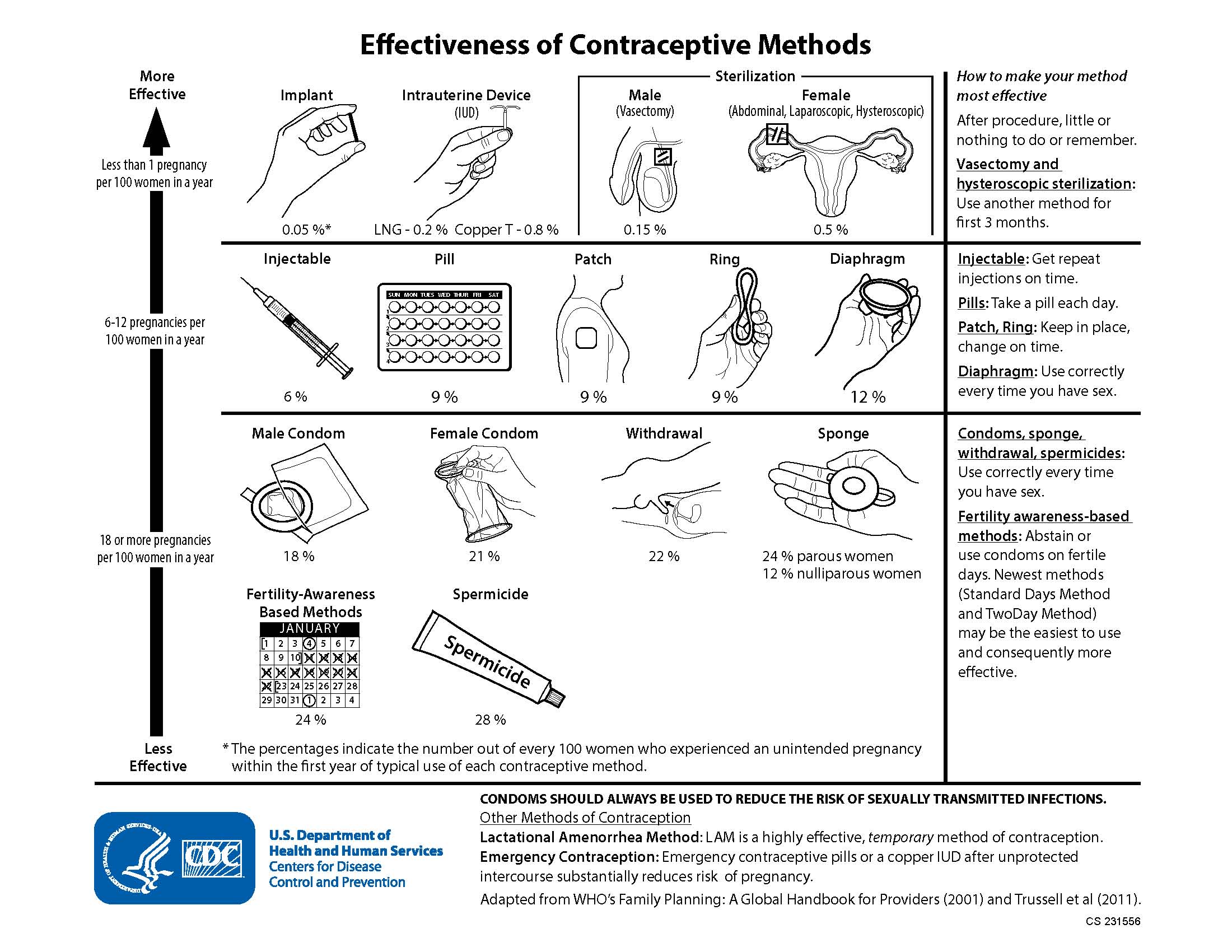
Effectiveness of Contraceptive Methods

birth_control_pills
Contraception is just that “contra-inception,” it opposes the inception of new human life. Put another way, these are methods of preventing unwanted pregnancy.  There is a rich and important debate revolving around the ethics of contraception, especially where they might overlap with abortifacients. But setting that debate aside for a moment, both pro-choicers and pro-lifers can agree that its better to not have people getting pregnant who do not want pregnancy, than to have a whole spate of unwanted pregnancies. The “cure” might be to “want” the pregnancies, to “terminate” the pregnancies, or to prevent pregnancies. But the point of agreement should still be clear.

Below is a chart by the Center for Disease Control (CDC) on the effectiveness of various birth control methods at preventing pregnancy. Their statistics are usually pretty good, though sometimes incomplete. Those who read this chart should be aware that these statistics do not address whether the pregnancy-prevention method prevents fertilization (conception of a new human life) or implantation (where the conceptus/zygote implants on the uterine wall). This difference is, by many pro-life advocates, a matter of life and death since the former would be contraception (purely speaking) the latter would be an early stage abortion.

*Click to enlarge

effectiveness_of_contraceptive_methods

http://www.cdc.gov/reproductivehealth/UnintendedPregnancy/Contraception.htm

Posted in Uncategorized | Leave a comment

Abortion Methods Over the Centuries, coming soon.

For a pro-choice rendering of historical abortion methods see: http://www.plannedparenthood.org/resources/research-papers/history-birth-control-methods-26784.htm

Posted in Abortion Practices, Contraception Practices, Family Planning, History of Abortion, Kinds of Abortion | Leave a comment

Abortion Legislation – Recent Developments. Coming soon!

Supreme.Court.Blurred
Abortion is generally legal, as decided by Roe vs. Wade (1973). But more narrowly speaking, States were also granted the privilege to limit and curtail abortion practice to prevent abuse, or, for example, treating abortion like a form of contraception. Several brands of abortion-restriction have successfully passed at the state level. These are:

1) Late-term Abortion Bans (banning 24 weeks/3rd trimester)
2) Fetal Pain Bill (banning 20th week-later abortions)
3) Parental Consent
4) Informed Parents
5) Waiting Period

Posted in Uncategorized | Leave a comment

Abortion in Cases of Rape

In the battle over Abortion, one of the most common kinds of artillery is also the most eviscerating. The issue is over rape-pregnancies. This ammunition is powerful in arguments on abortion since it multiplies two emotionally charged settings together: abortion and rape. And it’s admittedly hard, even for many avowed “pro-lifers,” to tell a rape-pregnant Mother that she should not go through with an abortion.

The anti-abortion or pro-life camp can be charged, therefore, with being callous towards women’s suffering, insensitive to the real problem of rape, and even participants in a broader “rape culture.” Responses to this line of attack have been mixed. Consider representative Todd Akin’s term “legitimate rape” (see here and here). Understood in context, he most likely meant something like, “Cases which are trully non-consensual sex and not something else like a false accusation or a legal technicality.” But by saying “legitimate rape.” He  was bound to be labeled as a sociopath, sicko, or idiot as if he was saying that rape is sometimes justified or good. Hence follows Hal Herzog’s rebuttal,

“[Akin’s] first mistake was linguistic.
The term “legitimate rape” is an oxymoron.
‘Legitimate rape’ does not exist. End of story.”

It should be obvious that no one is supporting rape, advocating for it, or seeking to legitimize rape. Neither abortion-opponents nor abortion rights advocates want that. At least two key questions remain then:

1) Does rape have some reduced chance of pregnancy? (as Representative Akin seemed to think)
2) Does rape justify abortion?

Concerning the first question, there seem to be some mixed reports. Some suggest that rape cases have a significant or even heightened chance of pregnancy (also see here and here). Others suggest that the trauma of rape still tends to inhibit chances of pregnancy. This facet of the debate is tough to mediate because, for example, statutory rape, rape pregnancy that miscarries, rape cases of infertile women, falsely accused rape cases, and cases where the coercive force was not till late in the intercourse could all count as statistical equals–all are reported as rape. Rape reporting is not always consistent or clear either. Moreover, there is no objective way to psychologically quantify and compare trauma between rape cases. All cases of actual rape are tragic and are liable to leave lifelong scars on many levels.

Some experts concede that rape cases are comparable to consensual intercourse in their chances of causing pregnancy. Let’s suppose, for the sake of argument that this is true. Little is lost here, for the pro-lifer, since question one has little bearing on question 2. Even if rape-pregnancies were common they still might not justify abortion. Furthermore, we may suppose (at least) for the sake of argument, that only about 5% of rape victims report subsequent pregnancy, and further that those are an even smaller percentage of the total number of pregnancies. That means rape cases are a small fraction of the total number of pregnancies. If someone supports abortion-on-demand because of rape-pregnancies, then they might need to consider how that aligns them with much country’s laws prior to Roe vs. Wade (1973), when “abortion on demand” was still illegal. Rape and medically dangerous cases were customary exemptions, considered too callous and troublesome to prosecute. If rape cases are just a fraction of the pregnancies in America it seems “abortion-on-demand” is not a specific and careful enough answer to the problem, for it allows many millions of abortions for the sake of <1,000 or so rape pregnancies.

Nevertheless, that aside can be left aside for a moment. These small numbers might factor into policy concerns, and legislation, but they don’t speak specifically to individual rape victims. Many pro-lifers would gladly embrace anti-abortion legislation that prohibits “on-demand” status with the exception of rape and medically dangerous pregnancies, not because they think such cases of abortion are “good” or “justified” but because they consider it a moral gain to allow several hundred or a thousand abortions so as to prohibit millions of other abortions.

Let us suppose then, for the sake of argument, that rape cases result in pregnancy about as often as with consensual sex. The gross number of rape-pregnancies might be far less than consensual pregnancies, since rape is itself less common, but that factor does not necessarily make any individual abortions good or evil.

Where does that leave the pro-lifer?

Moving on to Question 2: Does rape justify abortion? The core of the pro-life argument remains unchanged; it has typically been about the human rights of the fetus. The child-in-utero has a right to life just as any other human being has a right to life. Strictly speaking, rape is a tragic tangent to the issue since abortion doesn’t “cure” rape. It doesn’t unrape any victims. It doesn’t capture and prosecute the rapist. It doesn’t necessarily fix any physical or emotional scars for the victim. It certainly addresses a great burden of responsibility to a woman who may not be ready to face 9 months of pregnancy or subsequent motherhood; and the rape itself has violated her bodily autonomy and her sexual selectivity or even sexual sanctity.

But what problems does abortion fix for the rape-victim?

It would seem that child-birth is an added pain on top of the pain of rape. Enduring pregnancy, or motherhood, would serve as a constant reminder of the rape. Even the child’s appearance can bear some semblance to the rapist, adding additional insult to injury.

Yet the crux of the pro-life argument remains intact. All of these justifications fail to show that the fetus lacks a right to life. The child is not guilty of rape, and so it does not deserve capital punishment. The child did not “consent” or “coerce her” but was itself brought into this scene without any choice in the matter. The child and the mother are both victims.  The “evidence” proposed in defense of abortion might work towards adoption, or might show how rape is terrible and should be heavily prosecuted and stridently opposed, but it fails to justify abortion.

Abortion adds capital insult to injury. Abortion punishes two victims, killing the child, and adding new trauma to the mother. Abortion absolves the rapist of an additional duty, to pay child support (that is, legal pay restitution on top of his criminal punishment). And by taking a life, abortion forever ends any chance of salvaging the redemptive and beautiful life that was forged in wickedness. Nothing can fully redeem rape and justice should be served. No one is saying rape is good or instrumentally excused. No, none of that. Rape is always evil, but where it does happen it’s force can and should be muffled (at least somewhat) by a society that is determined to defy selfish destructive behavior with selfless love, virtue, and in this case, new life.

The rape victim can never undo that horrible experience of rape; she still has to find ways to cope. She could resort to unhealthy means like drugs, alcohol, broken relationships, bitterness, depression, etc. It’s not clear at all that abortion is “trauma free” or psychologically normal, easy, or comfortable for women. Even pro-choicers usually admit that abortion is regrettable even if it is (in their eyes) sometimes necessary. The rape victim however does not have to resort to abortion or to destructive coping mechanisms. She can instead grieve a healthy grief, mourn what was lost, seek out cushions of hope and understanding through the support of loved ones, through counseling, through faith, all the while admitting that rape is never okay, never good, and it’s a real tragedy. She has the tough task of drawing beauty from the ashes, to make evil into art. In that almost superhuman task, there are few expressions of redemptive beauty more amazing and powerful than the life of a child. Childbirth itself has been an archetypal example of “worthwhile” pain as it serves in bringing new human life into the public world.

If you are a victim of rape, if you are pregnant, please let me encourage you not to treat that baby with the scorn that the rapist deserves. What happened to you is terrible and should never have happened. Please do not punish that child for the sins of its father. If you absolutely cannot go through with keeping the baby, please consider adoption, so no one else has to die for evil that was done to you.

Posted in Abortion Cases, Abortion Laws, Ethics of Abortion, Family Planning, History of Abortion, Kinds of Abortion, Philosophy of Abortion, Terms and Definitions, When does Life Begin? | Leave a comment

The Roe vs. Wade Decision


The Supreme Court case of Roe vs. Wade (22 January 1973) is the landmark U.S. decision legalizing abortion on demand in the U.S.A. It is not without its caveats, as it restricted late term (3rd trimester/post-24 weeks) to “health” reasons. Understood in tandum with the concurrent case, Doe vs. Bolton, given on the same day of January 22, 1973, this case is considered by abortion advocates to be a watershed decision for women’s rights. The full text can be read here. The full text of the Doe vs. Bolton case can be read here:

Posted in Abortion Cases | 1 Comment

15 Anti-Abortion Arguments

Picture by: Unknown (accessed 6 May 2013 at: http://www.byrdnick.com/archives/3263#comment-175)

Arguments Against Abortion
(c) John D. Ferrer, 6 May 2013

The Overall Argument

Premise 1) Legality, where possible, should line up with morality.
Premise 2) Abortion-on-demand is immoral yet can banned.
Conclusion) Therefore abortion-on-demand should be banned.

Comments

a)   Exceptions can be made, as needed, for tubal pregnancies, rape, incest, etc.
1) Objectifies Humans P1) Human beings should be treated as subjects, not objects.
P2) Abortion treats human beings as objects
Conc.) Therefore abortion is wrong.
a)   The objectification is as instrumentally inconvenient human life.
b)   See Kant’s Categorical Imperative
2)  Death Penalty P1) It is immoral to issue a death penalty in cases of a morally innocent or neutral party.
P2) Abortion is a death penalty to morally innocent/neutral parties.
Conc.) Therefore abortion is immoral.
a) Neutral on whether the actual death penalty is ethical or not.
b) The preborn could be non-moral (like rocks or cats), and this still works.
3)  Animal Abuse P1) It is immoral to abuse higher-order animal life for convenience.
P2) Abortion abuses higher order animal life.
Conc.) Therefore abortion is immoral.
a) Ex., Endangered species and pets
b) Even animals for consumption are protected by abuse laws.
4)  Right to Life
(see, #9)
P1) Human rights, including right to life, extend to every “member of the human family” from creation onward (i.e., conception).
P2) Abortion militates against human life from conception to birth. Conc.) Therefore, abortion militates against a human right.*
a) See preamble of Universal Declaration of Human Rights (1948); Decl. of Indep. (1776); and  Declaration of the Rights of the Child (1959).
5)  Life Dilemma P1) The right to life should be honored except in cases of a moral dilemma where an equal or greater moral value is at stake.
P2) Liberty is not an equal or higher moral value than life.
Conc.) Therefore the life should be honored above liberty.
a) Moral dilemmas must have only evil options, even if one is considered “less evil” than the other.
6)  Liberty/Bodily Sovereignty Dilemma P1) Only in certain dilemma contexts can someone morally and rightfully infringe on another human being’s body/bodily sovereignty.
P2) Most abortions are not such dilemmas.
Conc.) Therefore, most abortions are immoral.
a) Moral dilemmas must have only evil options, even if one is considered “less evil” than the other.
7)  Baby Lottery P1) Contracts are morally binding.
P2) In cases of pregnancy from consensual sex, the mother has implicitly agreed to a natural contract by entering the baby lottery even if she did not know she’d “win” that lottery.
Conc.) Therefore, such mothers are morally bound not to abort.
a) Knowingly, willingly entered, not concerning illegal/immoral such as aid and abet a criminal, lie under oath, etc.
b) Refers to a “natural” contracted, once pregnant, to bring that child to term insofar as she’s capable.
8)  Unwanted Baby P1) It is conventional wisdom that a pregnant woman who is planning to bring that child to term is carrying a baby.
P2) One’s natural status doesn’t change simply by the desires/beliefs of another.
Conc.) Therefore, lacking a desire to be pregnant/”keep the baby” does not change the fact that it is a baby.
a)   Ex.: if I don’t think you’re American, that has no affect on your citizenship.
b)   Imply’s that (1) Intentionally killing babies for the sake of convenience is immoral. (2) Abortion does that. (3)Therefore, abortion is immoral.
9)  Created Equal P1) The Declaration of Independence recognizes that “all men are created equal” and they are “endowed by their creator with certain unalienable rights . . . Life, liberty and the pursuit of happiness.”
P2) Conception is the point of creation for every human being.
Conc.) Therefore, all men are “equal” and “endowed” with the right to “life” from conception onward.
a)    Draws on the founding documents for legal/judicial support.
b)    The laws of the land however are largely phrased towards legal citizens (and preborns are not that).
10)Discrimination P1) Abortion discriminates (a) against a defenseless class of people for (b) the convenience of another class of people (c) on the basis of size, level of development, environment, and degree of dependence.
P2) Discrimination on such bases is immoral.
Conc.) Therefore abortion is immoral.
a) Not all discrimination is evil, but that which involves a basic right to life and selects between preferred sizes, handicaps, and convenience is evil.
11)Ownership Objection
(see also, Obj. 2)
P1) It is unethical for one human being to own another.
P2) Abortion, in treating the fetus as the mother’s bodily property, constitutes ownership of one human being by another.
Conc.) Therefore, abortion is unethical.
a)    Ownership is a kind of objectification, and thereby unethical.
b)    Parent-child relations are not ownership but wardship.
12)Irresponsibility /Consistency Check P1) If abortion is ethical, then so is a pregnant mother who knowingly drinks alcohol, smokes, or misuses prescription.
P2) Those acts are not ethical for a pregnant mother.
Conc.) Therefore, neither is abortion ethical.
a)The pro-choicer who affirms abortion on grounds of “privacy” must also affirm any mother’s right to harm her own body, child included.
13)BurdenAnalogy P1) If children can be aborted strictly because they’re burdens, then so can born infants (or teenagers, or adults) be aborted.
P2) Infants cannot rightfully be killed for being burdensome,
Conc.) so children in utero should not be aborted for that reason either
a) The “burden” argument works equally well for any other people group that’s burdensome.
14) Parental Duty P1) Parents have a natural right and duty to care for their children.
P2) The conceptus is a “child in utero.”
Conc.) Therefore parents have natural right to care for the conceptus.
a)Most family law on child abuse/neglect hinges on this innate duty of parents to the children and children to their parents.
15) Slippery Slope P1) Defining morally relevant “personhood” as starting at birth is arbitrary when distinct human life had already begun at conception.
P2) Arbitrary definitions are susceptible to the “slippery slope” of a thing are interchangeable (i.e., birth/ adolescence, 18 years old, etc. is when personhood begins, etc.).
Conc.) Therefore, defining morally relevant “personhood” as starting at birth is interchangeable with other definitions (i.e., birth, adolescence, 18 years old, etc.).
a) Points out the trouble w/ various starting points for human life after conception.b) R. Reagan, “I should like to know if taking this old Decl. of Indep. , which declares that all men are equal upon principle and making exceptions to it, where will it stop.” (Abortion and the Conscience of the Nation, Thomas Nelson, 1984), 28.
Posted in Abortion Cases, Abortion Laws, Contraception Practices, Ethics of Abortion, Family Planning, History of Abortion, Kinds of Abortion, Philosophy of Abortion, Scholarly Reviews, Terms and Definitions, Uncategorized, When does Life Begin? | Tagged , , , , , , , , , , , , , , , , | Leave a comment

Case History of Abortion in America – A Survey (By: John D. Ferrer, 6 May 2013)

With the founding of America in the 15th to 18th centuries, early America was very Christian in its leanings, but that form of Christianity was colored by various historical factors including (1) the protestant reformation, (2) church-state conflicts in Europe, (3) rising political liberalism (i.e., John Locke, Alec de Toqueville, etc.), (4) the French Revolution, (5) the French Wars of Religion, (6) the Enlightenment, (7) Modern Science, and the (8) American Dream. The views on abortion were shaped by British common law, Natural Law Ethics, Christian scriptural/Biblical ethics.

Broadly stated, human life was thought to be “sacred” in a secular and religious sense (i.e., set apart as deserving special protection and the highest value). Traditional family values, traditional family roles, and great individualism were normal to America from its founding up through to till roughly the 1950’s.

Case History of Abortion in America

British Common Law (17th-mid. 18th century) Abortion is legal in all States prior to the quickening, as fetology at the time was not clear about when human life began. It was widely thought life began only then when mother detects fetal movement.
Lochner v. New York (1905) NY Worker’s Union case. Court ruled for individual liberty on basis of “substantive due process.” This ruling was decried by later Supreme Court verdicts (1937>) for reading economic theories into the constitution; instead, civil rights are the more proper domain for these kinds of rulings.
State courts (1850-1960) All states pass laws banning abortion. A common exception is in case of mortal threat to the mother.
Sherri Finkbine (1962) Unwittingly taking Thalidomide (A.K.A., “monster maker”), Finkbine carries a deformed child in utero. Seeking a legal abortion she is denied in the U.S. raising sympathy for abortion in the U.S.
State Courts (1962-1973) 17 states pass/amend laws opening abortion to cases of rape, health risks, and fetal damage. Four states, AK, HI,NY,WA, allow it at woman’s and doctor’s discretion. Only PA kept full abortion ban.
Griswold v. Conn. (1964) Married couples have a right to use contraceptives. Right to privacy is an implied constitutional right.
Eisenstadt v. Baird (1971) Singles (non-married & non-couples) have a right to use contraceptives. Right to privacy is extended.
Roe v. Wade (1-22-1973) Legalized Abortion on demand by way of right to privacy. Fetus’s are declared “non-persons,” not covered by the 14th Amendment of the Constitution.
Doe v. Bolton (1-22-1973) Expanded abortion legally to include any distress as a health reason. “On-demand” status now includes psychological distress and most any need or interest of the mother.
Planned Parenthood v. Danforth (7-1-1976) Supreme court overturns a Missouri law requiring husband’s consent for abortion.
Beal v Doe (1-11-1977) States aren’t required to pay for non-therapeutic (not medically required) abortions by medicad
Harris v. McRae (6-30- 1980) Supreme court upholds Hyde Amendment (Social Securities act) restricting Medicaid funding for abortion to cases of life endangerment, rape, or incest.
H.L. v. Matheson (March 23, 1981) States may require doctors to inform the parents of a teenager’s planned abortion.
Webster v. Reproductive Health Services (7-3-1989) Affirmed that, “The life of each human being begins at conception.” States have regulatory rights but can’t outlaw abortion. These include banning use of public facilities and employees to perform abortions. Also state’s must test for viability at 24 weeks of gestation.
Hodgson v Minnesota (6-25-1990) Minnesota law is upheld requiring parental consent for abortion.
Planned Parenthood v. Casey (6-29-1992) State rights are extended to include making laws which require counseling, parental consent, and waiting periods so long as they do not involve “undue burden” or “substantial obstacle” to the mother.
Stenberg v. Carhart (6-28- 2000) Nebraska ban on partial birth abortion is struck down invalidating similar laws in 30 other states.
Partial-Birth Abortion Act of 2003 (11-5-2003) G. W. Bush signs into law a prohibition on certain abortion procedures, namely, partial birth abortion.
Gonzalez v. Carhart and Gonz. v. Planned Parent. (4-18-2007) The ban on partial birth abortion is upheld, departing from past rulings that struck down any such bans if they did not carry exceptions for protecting women’s health (generally).
Pain Capable Unborn Child Protection act (2012) Passed in several states including GA, NE, AL, KS, and ID banning abortion after the 20th week of pregnancy but it’s allowed if the mother’s life is in danger.
McCorvey v. Hill (2-22-2005) Norma McCorvey (Jane Roe) sought to overturn the ruling of Roe v. Wade. The Supreme Court upheld the decision of Roe v. Wade.
Pre-abortion Ultrasound Act (2007-pending) Passed in various forms in 12 states. This act requires ultrasound before giving an abortion.
Posted in Uncategorized | Leave a comment

Abortion News

News.Blue.2

Boycotts Looming For Eden Foods over “Hobby-Lobby-esque” Contraception Coverage (18 July 2014)

Congress Blocks Bill to Restore Contraceptive Coverage in Wake of Hobby Lobby Case (16 July 2014)

Abortion Clinic Protections Proposed in Massachusetts (14 July 2014)

High School Sophomore Speaks Out Against Hobby Lobby Ruling (8 July 2014)

Opinion: Hobby Lobby Lavishes Contraception Coverage On Employees (30 June 2014)

Supreme Court Rules in Favor of Hobby Lobby on Contraception Coverage Exemption (30 June 2014)

Supreme Court Rules Against 35-foot Buffer Zone for Abortion Clinics (26 June 2014)

Pending Hobby Lobby Case Threatens to Redefine Personhood and Religious Freedom (21 March 2014)

Stakes are High In the Hobby Lobby Case (27 November 2014)

Eugenics Alive and Well in the U.S. (10 July 2013)

Chilean Leader Praises 11 Yr. Old Rape Victim for Refusing Abortion (10 July 2013)

TX House Passes Contentious Abortion Bill (10 July 2013)

TX Anti-Abortion Bill Revote Imminent (
9 July 2013)

Battle Over Abortion Here to Stay (9 July 2013)

Texas House Set to (Re)vote on Abortion Restricstions (9 July 2013)

Texas Law Could For Closure of Some Abortion Clinics (6 July 2013)

Church of Satan Distances Itself from Pro-Abortionist Chant “Hail Satan!” (5 July 2013)

Texas Bill Clears First Hurdle After Filibuster (3 July 2013)

Austin, TX Pro-Abortionist Crowd Chants “Hail Satan!” (4 July 2013)

Austin, TX Pro-Choice Protestors Hired Through Craig’s List (1 July 2013)

Socialistis and Occupy Protesters Help ‘Yell Down’ Abortion Bill (28 June 2013)

Media Sides With Death, Wendy Davis Is Not a Hero (27 June 2013)

Special Session for Passing Texas Pro-Life Law (26 June 2013)

Abortion Controversy Swirls Over Late TX Senate Proceedings (26 June 2013)

Texans on Verge of Passing Abortion Clinic Restriction Law (24 June 2013)

Maddow: Wisconsin and Texas Abortion Laws Have Gone Too Far (22 June 2013)

“People’s Filibuster” Halts Abortion Bill (21 June 2013)

TX Abortion Restriction Bill Filibustered (21 June 2013)

Huge Turnout for Citizen’s Filibuster over TX Abortion Bill (21 June 2013)

Planned Parenthood to Support Obamacare in Every Office (20 June 2013)

House Passes Ban on Late-Term Abortion (19 June 2013)

House Ok’s 20-week abortion Ban (19 June 2013)

Dem Opposition to 20-week abortion ban led by Lofgren (19 June 2013)

Rep. Marsha Blackburn: Opinion Piece Against Abortion (18 June 2013)

Exceptions added to the Pain-Capable Abortion Ban (17 June 2013)

Rape Exceptions added to the Pain-Capable Abortion Ban (16 June 2013)

Abortion Bill Pushes Constitutional Limits (15 June 2013)

Boehner Defends Abortion Discussion (13 June 2013)

Judge Approves Morning-After Pill Plan (12 June 2013)

“Incidence of Rape Resulting in Pregnancy very low” Rep. Trent Franks (12 June 2013)

Morning-After Pill Won’t be Blocked, says Obama (10 June 2013)

Abortion Issue In Filibuster (6 June 2013)

NFL center, Matt Birk declines W.H. visit over Obama’s “God Bless Planned Parenthood” (6 June 2013)

Dems Resume ‘War on Women’ language for Repubs (5 June 2013)

Infanticide Case in China Halted (29 May 2013)

S. Korean Pastor Intro’s Dropbox for Unwanted Babies (28 May 2013)

Court Blocks Bill Defunding Planned Parenthood in Indiana (28 May 2013)

Myanmar adopted Chinese-style Abortion Policy . . . against Muslims (28 May 2013)

Gosnell Sister Used Garbage Disposal On Fetal Remains, Gets Probation (28 May 2013) 

Probe Continues In Maternal Death From Botched Abortion (28 May 2013)

Arkansas Post-12 Week Abortion Ban Postponed (17 May 2013)

TX House Bill 15 Causes Cancer? (17 May 2013)

ND Abortion Clinic Sues State for Right to Stay Open (15 May 2013)

Probe Demanded for Abortion Doc Who Twisted Heads Off Babie (15 May 2013)

Pro-Life Groups Targeted in IRS Scandal (15 May 2013)

Philly Abortion Doc Sentenced to 3 life Terms, No Parole (15 May 2013)

DC Abortion Fund Helps Immigrants, Poor and Underprivileged Pay for Abortion (13 May 2013)

Administration Does Disservice to Public on Emergency Contraception (10 May 2013)

When Health Care Providers Refuse Care Whose Rights Are At Stake? (8 May 2013)

Late Term Abortion like “Meat in a Crock Pot” (8 May 2013)

NC Bill Requires Education for Abortion (8 May 2013)

Gosnell Trial, all about Location, Location, Location (8 May 2013)

So Long Pro-Choice, I’m Pro-Faith (7 May 2013)

Colorado Supreme Court Rejects Catholic Health Case, Punts on Fetal Rights (6 May 2013)

Abortion Rights Community Has Become the NRA of the Left (6 May 2013)

Cardinal Brady Calls Abortion Legislation “Morally Unacceptable” (6 May 2013)

Obama Admin Gives Up Forcing Bible Publisher to Obey HHS Mandate (6 May 2013)

First Slavery Now Abortion, Blacks bear the Brunt of Americas Lost Moral compass (6 May 2013)

Baby born alive was tossed into a bag and thrown on the roof of the abortion clinic (6 May 2013)

The Silence of the Lambs [The Media Blackout on the Kermit Gosnell Case] (3 May 2013)

Morning After Pill Available Over the Counter for 15 Year Old Girls (3 May 2013)

Alexander Sanger: History of Abortion (29 April 2013)

My Wife Is Expecting Twins and I Am Not Happy About It (24 April 2013)

Brian Sims, Pennsylvania Democrat, On Abortion: We Did Not ‘Swear To Uphold The Bible’ (VIDEO) (23 April 2013)

Arkansas Passes The Fetal Heartbeat/12 Week Bill (21 April 2013)

Medications Used to Treat Rheumatoid Arthritis May Affect Abortion Rate in Women (16 April 2013)

Abortion Bans Move to the Fore says Guttmacher Survey (11 April 2013)

Kansas Abortion Bill Passes House, Sent to Governor for Signature (6 April 2013)

Kids Less Sexually Active Than People Think (2 April 2013)

North Dakota Abortion Ban Signed By Governor Jack Dalrymple (26 March 2013)

Houston Doctor Accused of Illegal Abortions (17 March 2013)

Wayne Besen Editorial: On Fetal-Heartbeat Pro-life Laws (11 March 2013)

Repub. Ann Clemmer Backs Toughest Anti-Abortion Bill, The Fetal-Heartbeat Law (7 March 2013)

John Boehner: Ending Abortion is ‘One of our most Fundamental Goals This Year’ (25 January 2013)

Analysis of Roe v. Wade and Arrests of and Forced Interventions on Women (2o January 2013)

Gov. Rick Perry’s Sister Stands to Profit off of Bill Restricting Abortion Clinics (10 October 2012)

Anti-Abortionists Picket Clinic’s Landlord (9 August 2011)

Late-Term Abortion Doctor Admits “I Kill Children” (6 November 2009)

Woman Who Aborted Deformed Fetus Defends Procedure (8 November 1995)

Posted in Abortion Cases, Abortion Laws, Contraception Practices, Ethics of Abortion, Family Planning, History of Abortion, Kinds of Abortion, Scholarly Reviews, Terms and Definitions, When does Life Begin? | Tagged , , , , , , , , , | Leave a comment